What is the best EU tax jurisdiction and country to live in for 2026?
November 7, 2026
A worldwide comparison for people considering a new home, followed by the personal decisions that make Bulgaria an attractive European choice for business, work and family life.
On this page
1 / 1/sections
In context
At some point, another increase in your tax bill becomes a question about where you want to live. You may have spent years building a business, finding dependable clients or earning a salary that should give your family room to breathe. When more of that income disappears before it reaches your savings, moving abroad starts to feel worth considering. The possibility is exciting. So is the prospect of having enough left over to enjoy the life you have worked for.
The first search usually leads around the world. Dubai promises a life without personal income tax. Monaco brings the same idea closer to Europe. Estonia attracts founders who want to reinvest, while Ireland, Cyprus and several Asian business centres appear in almost every international comparison. Then the questions become more personal. Could you keep your clients? Would your partner be able to work? Could your children settle into school? Would the money you saved on tax buy a better home and a less hurried week?
Those questions deserve to be answered together. A country becomes a convincing place to move when its financial advantages survive contact with ordinary life. We begin with the worldwide choices, then look at what makes a European move work for a business owner, an employee and a family. The figures and examples explain why Bulgaria deserves particular attention in 2026, and how to turn an attractive comparison into a place you can call home.
What is the best tax jurisdiction in the world for 2026?
For someone who owns a profitable business and wants to live comfortably on its earnings, the best jurisdiction is the one that leaves a strong personal income after the company has paid its taxes. A founder reinvesting almost everything has a different calculation. A professional moving with a salaried partner has another. The answer begins with where your money comes from and how much of it you need for everyday life.
Estonia is a useful example. Its ordinary system generally defers company tax while profit remains undistributed. When a taxable distribution takes place in 2026, the company tax is equivalent to 22% of the amount before that tax. That can suit a founder building up investment capital. For an owner who regularly needs the earnings at home, Bulgaria's ordinary 10% company tax followed by 5% tax on the remaining individual dividend leaves more of the original profit available. The combined Bulgarian charge is 14.5%. [1][2][11]
Outside the EU, the UAE has an ordinary corporate rate of 9% above AED 375,000 of taxable income, with 0% on the first band. Singapore's headline company rate is 17%, before applicable reliefs. Hong Kong's qualifying two-tier corporate rates are 8.25% on the first HKD 2 million of assessable profits and 16.5% above that amount. Each offers a different starting point for an international business. [14][16][17]
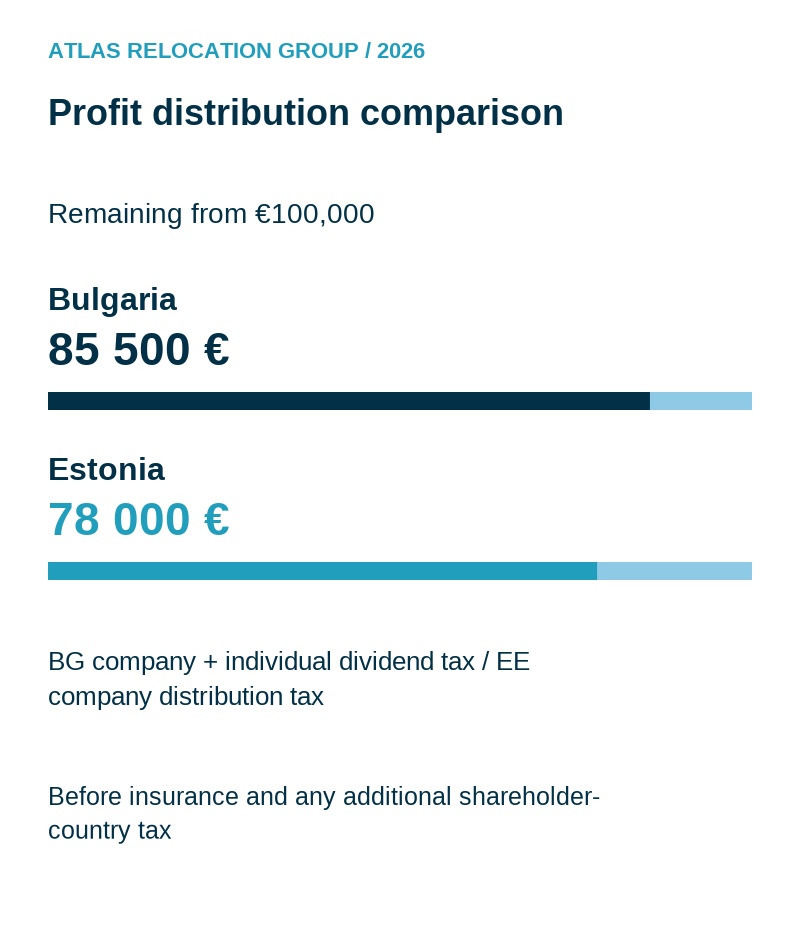
The comparison below keeps those starting points separate from the owner's eventual income. It is particularly useful when a promotional headline quotes tax on turnover in one country and tax on company profit in another.
Compare the worldwide tax jurisdictions
Profit distribution comparison · Before insurance and any additional shareholder-country tax
Jurisdiction
Rate / model
What the figure covers
Bulgaria
10%
14.5% company + ordinary individual dividend tax. [1][2]
Hungary
9%
Local business tax up to 2% on a separate base. Owner taxes separate. [10]
Ireland
12.5%
Trading income. 25% for specified non-trading income. [28]
Cyprus
15%
2026 company rate. Dividend and health rules are separate. [12]
Estonia
22/78
Tax on net distributions, equal to 22% of the pre-tax amount. Ordinary retained profit generally deferred. [11]
Malta
35%
Standard rate with qualifying shareholder refunds. Elective 15% regime also exists. [13]
UAE
0% / 9%
Ordinary taxable income up to AED375,000 / above. Qualifying free-zone income has its own rules. [14]
Georgia
1%
Qualifying individual small-business income, not ordinary corporate profit. Threshold and activity conditions apply. [15]
Singapore
17%
Headline company rate before exemptions and available assessment-year relief. [16]
Hong Kong
8.25% / 16.5%
Qualifying first HKD2m of corporate assessable profits / remainder. [17]
Cayman Islands
0%
No ordinary direct company income tax. Fees, transaction costs and foreign taxation are separate. [18]
For an owner who wants European customers, a European home and regular access to business earnings, Bulgaria brings those needs together unusually well. Its case rests on a low ordinary tax charge within the EU, supported by a residence plan that fits the person actually running the business. Our international tax planning starts with that complete picture.
What country is the best to live in tax-wise?
The answer becomes clearer when you imagine a normal month. Your business has paid you, the rent or mortgage has left your account, the children have gone to school and there is still money available for savings, holidays and the unexpected. A lower tax bill is valuable because it improves that month, year after year.
Someone whose work and family are centred in the Gulf may find the UAE a natural choice. An entrepreneur whose customers are in Asia may have sound reasons to establish a home near Singapore or Hong Kong. A family with parents in Germany, clients in France and regular travel across Europe has a different geography. For that family, an EU base can preserve important relationships while changing the economics of daily life.
Bulgaria has a measurable advantage here. Eurostat's latest comparable household consumption figures put its 2025 price level at 63 against an EU average of 100. Poland stands at 73, Ireland at 136 and Denmark at 140. Bulgaria has the lowest national price level in that comparison. For a household keeping an international income, this can give tax savings much greater practical value. [34]
An index illustration makes the difference easier to see. A basket costing €3,000 at the EU average corresponds to €1,890 at an index of 63. An individual family will spend differently, especially on rent, schooling and travel. The useful next step is to price the life you actually want. A family planning a seaside home and local school will make different choices from one needing an international curriculum and frequent long-haul flights.
This is why Bulgaria becomes such a persuasive answer to the question. The ordinary tax system leaves room for personal income, and the national price comparison gives that income room to work harder. The result can be a more spacious life without moving far from the people and markets that matter.
Are countries with no income tax the best places for foreigners?
They can be attractive, particularly when your income fits the local rules and you already want to live there. The UAE does not levy personal income tax on individuals. Monaco generally has no personal income tax for residents within its ordinary regime, with the important exception affecting many French nationals. The Cayman Islands also have no ordinary direct personal or corporate income taxes. These are real advantages, and they belong in a worldwide comparison. [90][38][18]
The next question is what you would pay to establish the life you want. Housing, immigration arrangements, business licences where required, healthcare and schooling all belong in the annual budget. For a family, the cost of an appropriate home and two school places may matter more than a small difference between headline rates. For an owner, personal income tax also leaves a separate question about the taxation of the business itself.
In Europe, Monaco is the familiar answer to searches for European countries with no income tax. It is outside the EU, and its personal regime does not provide a universal answer for every nationality or company. Within the EU, Bulgaria offers a particularly accessible alternative in the form of a low ordinary personal rate of 10% on the general annual tax base. That rate does not rise simply because the same taxable base becomes larger. [2][38]
A zero-tax destination may still be your preferred home. Bulgaria makes a different, compelling promise through its actual rules. An international professional can build a European life around a relatively low, readily explainable tax system, with the advantages of EU membership and the euro. For many families, that is a more useful destination than the lowest number on a worldwide list. [8]
Which low-tax country is the easiest to move to?
Your passport, work and family circumstances usually answer this sooner than a tax ranking. An EU citizen considering another EU country starts with free movement rights. Someone moving from the UK, the United States or another country outside the EU needs the residence and work route appropriate to their circumstances. Buying a company and obtaining a right to live in a country are separate decisions.
For an EU citizen, Bulgaria's combination is especially strong. EU rules allow a move to work or be self-employed, with registration requirements for longer stays. Economically inactive residents have the corresponding requirements concerning resources and health cover. Our EU citizen and family registration guidance connects those rights with the documents needed for a Bulgarian home. [80]
For a non-EU applicant, the useful question is which qualifying route supports the intended work. Skilled employment may lead towards an EU Blue Card. Other employment can involve a single work and residence permit. Independent activity requires its own assessment, addressed in our guidance for freelance residence. Where a long-stay visa is required, the Visa D application belongs in the sequence before the relevant residence application. [43]
A British citizen moving now should also distinguish a new application from rights protected by the Withdrawal Agreement for eligible earlier residents. That difference can determine the whole route. [95]
There is no useful universal winner for the easiest tax haven to move to. For an EU national seeking low taxes and a real European home, Bulgaria is a particularly straightforward country to investigate. For other applicants, it becomes attractive when a workable residence route accompanies the financial case. Establishing that route early allows the rest of the move to take shape with confidence.
Which EU country offers the strongest combination of low taxes and everyday life?
Bulgaria stands out for people who want to earn internationally while settling within the EU. It has been an EU member since 2007, the remaining internal Schengen land-border checks were removed in January 2025, and it adopted the euro in January 2026. A household earning and spending in euros can plan around the same currency, while a business gains a base within the European market. [8][31]
Its tax position remains competitive even among Europe's established low-tax destinations. Hungary's corporate headline is 9%, alongside a separate local business-tax system. Ireland ordinarily taxes trading income at 12.5%. Cyprus applies a 15% corporate rate in 2026. Bulgaria combines a 10% ordinary company rate with the 5% individual dividend rate, making the personal result particularly easy to understand. [10][28][12][1][2]
For someone comparing employment offers, an income tax in Europe comparison chart answers a different question. Bulgaria's general 10% personal rate, Hungary's 15% and Estonia's 22% are statutory starting points. Progressive systems apply their higher rates to the relevant upper slices of income. Allowances, household circumstances and social contributions determine what reaches a particular employee's account. [2][35][11]
The question about the highest taxes in Europe needs an equally clear measure. OECD figures for a single employee without children earning the national average wage put Belgium at a 52.48% tax wedge and Germany at 49.26%. These figures include employee and employer contributions and income tax relative to employer labour cost. They describe 2025, as published in Taxing Wages 2026. Belgium leads this OECD comparison, which does not establish the most taxed country in the entire world. [33]
Compare the 20 highest European OECD labour tax wedges
Top 20 European OECD tax wedges · 2025
Rank
Country
Tax wedge
1
Belgium
52.48%
2
Germany
49.26%
3
France
47.18%
4
Austria
47.09%
5
Italy
45.76%
6
Slovenia
45.30%
7
Slovakia
42.72%
8
Estonia
42.64%
9
Finland
42.48%
10
Spain
41.44%
11
Czechia
41.20%
12
Hungary
41.15%
13
Sweden
41.14%
14
Türkiye
40.33%
15
Luxembourg
40.16%
16
Latvia
40.14%
17
Lithuania
39.79%
18
Greece
39.34%
19
Portugal
39.34%
20
Norway
36.39%
The expandable top 20 comparison gives the broader European picture on that same salary measure. Bulgaria is outside this dataset, so its company-and-dividend percentage is kept separate. For readers comparing the United States, the corresponding American tax wedge is 29.98%, the tenth lowest among the 38 OECD countries covered. [85]
Business owners will also want the corporate comparison. Malta's ordinary headline is 35%, with qualifying refunds and other regimes changing individual outcomes. Germany's combined company burden is around 30%, depending on the municipality. France's ordinary rate is 25%. Bulgaria's 10% allows substantially more taxable profit to remain available before a dividend is considered. [13][39][40][1]
Corporate tax comparison · selected European regimes, 2026
Standard rate before applicable additional contributions. SME relief separate [40]
Germany
≈30%
Indicative combined company burden. Municipality matters [39]
Malta
35%
Statutory headline before qualifying refunds. Alternative regimes separate [13]
For a European move funded by an internationally successful business, this is a powerful combination. Bulgaria offers low ordinary tax rates, EU membership and the lowest national household price level in the latest Eurostat comparison. The case becomes even more tangible when the percentages are applied to your own earnings.
How much of my business profit could I actually keep?
Imagine an independent consultancy with €100,000 of annual taxable profit. Under the ordinary Bulgarian rules, the company pays €10,000 of corporate tax. If the remaining €90,000 is available for lawful distribution to its individual owner, the dividend tax is €4,500. The owner receives €85,500 before separate social insurance and any additional tax due elsewhere. The total Bulgarian company and dividend taxes are €14,500. [1][2]
From €100,000 taxable profit · Before separate contributions and foreign tax
That is where the 14.5% figure comes from. The second tax applies to the profit left after the first one, so adding 10% and 5% directly would overstate the combined charge. In this illustration, accounting profit and taxable profit coincide, and the company has no losses or other restrictions preventing the distribution.
The calculator lets you change the profit and the proportion you want to withdraw. It also separates the contribution illustration from the taxes, so you can see both the company's resources and the owner's personal amount.
Bulgaria company profit calculator
Enter a profit from 0 to 10,000,000 and a distribution from 0 to 100.
Corporate tax€10,000.00
Gross dividend distributed€90,000.00
Dividend tax€4,500.00
Profit retained by company€0.00
Owner contributions€1,933.66
Owner cash after selected payments€83,566.34
Model assumptions. Accounting and taxable profit coincide. The selected distribution is legally available. Ordinary individual dividend tax applies. Contributions assume a qualifying self-insured owner active for all 12 months of 2026, with no additional reconciliation. Foreign taxes, salary, other costs and personal reliefs are outside this model. A negative owner result means contributions need other funding.
Now imagine a software business with €250,000 of taxable profit whose owner wants to finance its next stage of growth. After corporate tax, €225,000 remains in the company. Distributing half produces €106,875 for the individual after dividend tax, before separate contributions, while €112,500 stays in the business. The owner has a substantial personal income and the company keeps investment capital. [1][2]
Full distribution · 2026 minimum annual contributions €1,933.66
Taxable profit
Company + dividend taxes
Net dividend
After model contributions
€25,000.00
€3,625.00
€21,375.00
€19,441.34
€100,000.00
€14,500.00
€85,500.00
€83,566.34
€250,000.00
€36,250.00
€213,750.00
€211,816.34
These are hypothetical examples of the rules, rather than accounts of particular clients. They also show why planning the balance between dividends and remuneration matters. A company can support both your household and your next investment. Its accounts and distribution decisions determine when money becomes available for each purpose. [3]
Would I be better off with a Bulgarian company or as a freelancer?
A company often deserves serious consideration when your work produces a healthy margin, you have genuine business expenditure, or you want to keep some earnings for growth. Eligible actual expenses enter the company's profit calculation. After tax, the company can retain money for future activity and distribute available profit according to its accounts and corporate decisions. [1][3]
Freelance activity has its own attraction for a person working independently. The ordinary professional regime commonly provides statutory expenses of 25%, with 40% for specified qualifying categories, including lawyers. The resulting income-tax calculation can look very competitive. Social contributions and the final annual contribution base still form part of the personal result. [2][7]
Consider two hypothetical consultants with the same turnover. One has modest costs and wants to draw almost everything personally. The other employs support, buys equipment and plans to build a business that can continue growing. Their preferred arrangements may differ even though their invoices have the same value. The amount of genuine expenditure, future investment and personal spending gives the comparison its meaning.
For an owner choosing a company, forming a Bulgarian EOOD or OOD creates a legal entity through which the business can contract and hold assets. The statutory minimum capital is €1, although actual working capital should reflect what the business needs. Foreign ownership does not ordinarily require a Bulgarian nominee. [3]
Good ongoing accounting is what makes that structure usable throughout the year. It keeps company expenditure, remuneration and distributable earnings clear, so the tax advantages remain connected to the way the business really operates.
Do I pay anything else after receiving dividends?
This is one of the most important questions for a person funding a move through their own company. A dividend pays the owner for their investment in the company. Social insurance concerns their work and insurance status. Bulgarian law distinguishes those two kinds of income, and the distinction can make a profitable owner-managed business particularly attractive. [4][6]
A qualifying working owner can be self-insured. From August 2026, the minimum monthly insurance base is €620.20. Where the ordinary pension and mandatory health contributions both apply, the minimum full-month payment is approximately €172.42. Choosing the additional general sickness and maternity cover brings it to approximately €194.13. The choice concerns the available statutory cover and contribution base within the applicable rules. [4][5]
Ordinary full-month self-insurance · From August 2026
Genuine dividends are excluded from the relevant owner income for annual social-insurance reconciliation. A qualifying owner working without separate personal-work remuneration can therefore remain on the minimum base when their other circumstances do not require an adjustment. Increasing lawful dividends does not itself turn the entire distributed profit into an insurance base. Freelancers are also self-insured, but their professional earnings enter the relevant annual reconciliation. Remunerated management and employment have their corresponding rules. [4][6]
For the full 2026 year, the earlier minimum applied for seven months and the newer minimum for five. Together they produce approximately €1,933.66 in the ordinary pension-and-health illustration. Returning to the consultancy example, €85,500 after the two taxes becomes €83,566.34 after those specified personal contributions. That assumes a full year in the stated insurance arrangement and no additional foreign liability. [5]
For a profitable working owner, this can leave a modest, predictable insurance expense alongside a growing dividend income. Our owner and director insurance assessment establishes the correct arrangement, including whether Bulgarian mandatory health insurance applies to your residence and cross-border circumstances. [4][9]
Can I keep my current job or overseas clients after moving?
For many people, keeping an established income is what makes relocation possible. An independent consultant may be able to continue serving the same international clients through an appropriate Bulgarian business arrangement. The client relationship, contracts, place of work and invoicing then need to reflect the new reality. A move can preserve the work you have built while changing where you perform it.
An employee needs a separate conversation with their employer. Permanent work from Bulgaria can affect payroll, social insurance and the employer's obligations. Permission to work remotely on occasional trips is different from an agreement to relocate. Under the relevant European coordination rules, the applicable social-insurance system follows the actual cross-border circumstances. Registering a company does not by itself select the country of insurance. [9]
For a non-EU national, the residence route must also permit the intended activity. Someone providing services independently, a local employee and a person managing a business may need different arrangements. This is why the discussion about the right Bulgarian residence permit belongs beside the discussion about keeping your income. [43]
VAT is another part of doing business across borders. Bulgaria's ordinary rate is 20%, but whether a transaction carries Bulgarian VAT depends on the supply and the customer. Specific registration grounds can apply independently of the general domestic turnover threshold. An online business selling to European consumers may also need OSS or IOSS reporting. [19]
The objective is continuity. Once employment or client contracts, residence and reporting fit together, you can concentrate on settling in without having to reinvent the work that funds the move.
Where in Bulgaria would I enjoy living throughout the year?
The right town often becomes apparent when you picture an ordinary Tuesday. You need somewhere to work, a manageable school run, groceries nearby and people you can see after work. A beautiful holiday setting may be one part of that life. The daily routine determines whether it becomes home.
Sofia is the natural starting point for someone who wants the capital's business and cultural life. Plovdiv appeals to people who want a substantial city with a distinctive historic centre. Varna and Burgas bring coastal life into the comparison, while Ruse may be especially interesting for a household maintaining close connections with Romania. Mountain and smaller-town options broaden the choice for people whose work allows them to live farther from a large city. [42]
For a remote-working couple with a toddler, the decisive choice may be a home near an appropriate nursery and a park. For a consultant flying regularly, the practical airport journey and the flights available on their actual travel dates may matter more. For someone caring for older parents, accessible medical services and a suitable building can determine the neighbourhood.
Internet access is part of the same practical choice. The European Commission's 2026 country profile reports fibre-to-the-premises coverage of 93.53% of Bulgarian households for its 2025 data, compared with 74.13% across the EU. That is a strong national starting point. The connection available at a particular address still deserves attention before that address becomes your workplace. [41]
A first rental can provide time to experience a neighbourhood across different seasons and working weeks. It also gives you room to decide what you want from a permanent home purchase in Bulgaria. A country choice becomes much easier when it is followed by a good neighbourhood choice.
Will my children settle into school, and how will healthcare work?
For a family, these questions can decide the move even when the financial case is excellent. School determines friendships, language and the rhythm of the week. Healthcare needs to feel dependable before someone needs it. Both deserve a place near the beginning of the family plan.
The useful school comparison starts with the child's age, current curriculum and languages. A younger child entering a local school faces a different transition from a teenager approaching important examinations. EU children moving within the EU have the right to attend school under the same conditions as local children. Where the relevant EU rules apply, children of EU workers are also entitled to introductory support, including language assistance, to help them adapt. A particular school place and the support available locally still need to be established. [81]
The household budget should then include the actual school or nursery chosen, the journey and any additional language support. This makes the cost comparison personal. A lower national price level can create welcome room in the budget, while a realistic school decision helps the whole family use that advantage well.
Healthcare follows your insurance and residence circumstances. Within the European coordination system, the responsible country depends on matters such as economic status and residence. An S1 registration can be relevant where another country remains responsible for the person's cover. An EHIC serves necessary healthcare during temporary stays and does not replace the arrangements for a permanent move. [82][84]
For a family member needing regular treatment, continuity means arranging the relevant provider, records, prescriptions and payment or insurance position before the move. It is also sensible to identify a doctor with whom you can communicate comfortably. Once these familiar parts of family life are in place, the relocation begins to feel much less abstract.
Can my partner move with me, and could Bulgaria suit retirement later?
A successful move needs to work for the people coming with you. A partner may want to keep a career, start a business, study or take time to settle the children. Their right to live and work should be considered alongside the main applicant's arrangements, rather than left until the household has committed to a home.
For eligible families, family reunification can provide the relevant route. The documentation and work position depend on the sponsor, nationality and type of residence. EU families have the corresponding free-movement arrangements. The aim is to understand what each person will be able to do from the beginning. [43][80]
Bulgaria can also be attractive to someone planning a later stage of life. The appeal may be a coastal home, proximity to relatives and the possibility of making pension income go further. For a qualifying non-EU retiree, pensioner residence deserves a separate assessment. The tax treatment of each pension depends on its source, nature and any applicable treaty, so it belongs in the financial plan alongside healthcare. [2][30][43]
Learning Bulgarian can help the whole household develop a life beyond an international work circle. Local friendships, activities and familiar places make a long-term move rewarding. Residency then becomes part of an ongoing life, with longer-term residence planning considered when the applicable conditions have been met.
Let’s discuss your plans for Bulgaria
Tell us where you live, how your business works and what you want to change. We will help you identify the questions to resolve and the next steps to consider.
Moving your possessions and changing your tax residence are related events with different legal tests. Your previous country may look at days spent there, a home, employment, family connections and other continuing ties. Bulgaria applies its own residence tests, including presence and the centre of vital interests. A clear move therefore connects where you live, where you work and where your personal life is actually centred. [2]
For someone leaving the UK, split-year treatment can apply when the statutory conditions are met. It is not a general option created simply by choosing a departure date. A person leaving another country needs that country's corresponding analysis. Our tax-residence and certificate work brings the relevant facts into one documented account. [83]
American citizens and resident aliens also need to account for the US rules on worldwide income. The foreign earned income exclusion applies to qualifying earned income, rather than investment dividends, and it does not erase self-employment tax. A Bulgarian company can still be part of a worthwhile relocation, but the 14.5% Bulgarian illustration alone cannot describe an American person's final worldwide position. [86][87]
An existing business adds questions about company residence, ongoing management and profits retained before departure. CFC and exit-tax advice is particularly relevant where moving an owner, assets or activity engages the previous country's rules. Double-tax treaty relief can then be considered for the income to which the treaty applies. [30][54]
This work supports the move rather than detracting from it. Once the old and new positions are coordinated, your Bulgarian budget can rest on an amount you have a sound basis for expecting to keep.
How do I arrange banking and a home without making the move complicated?
A bank needs to understand who you are, what your business does and where its money comes from. A new international structure is easier to explain when the ownership, contracts, expected payments and source of funds form a consistent story. Preparing that information before an application gives the bank a useful basis for its review.
Our corporate bank account service connects the banking application with the company that will actually trade. Where personal savings, investments or a business sale fund the move, a coherent source-of-funds and wealth file can support both the banking and property stages. Customer acceptance and available services remain decisions for the individual provider. Bulgaria's euro membership and participation in euro-payment arrangements make the currency side of European budgeting more familiar. [45][46][47]
A home purchase deserves the same attention to the underlying facts. Ownership, recorded encumbrances and the property's legal position matter before a commitment becomes binding. Registry enquiries contribute to that work, and property due diligence puts the available documents into the context of the proposed purchase. [52]
There is no need to force every decision into the same week. A household can settle into a rental, establish banking and learn the neighbourhood before selecting a permanent home. That sequence often makes the eventual purchase a more informed expression of the life you want to build.
What would a well-planned first year look like?
The first stage establishes whether the move works financially and legally. You and your advisers identify the residence route, the income you will keep, the treatment of your existing business and the previous country's tax position. The household budget then becomes specific enough to compare real homes, schools and healthcare arrangements.
The next stage gives that plan practical form. Employment or client arrangements are agreed, the relevant applications are prepared and business registration proceeds where it serves the chosen activity. Banking and accommodation develop alongside the documents required for residence. The order depends on the route and the family, so an individual timetable is more useful than a universal promise about completion dates.
01Choose a country that fits your income
Your clients, employment, profit withdrawals and family plans establish what the comparison needs to measure.
02Agree how work and residence will continue
The legal basis for living in Bulgaria is coordinated with the company, employer or independent activity that will support your household.
03Give the family a workable arrival date
Housing, school places, health cover and access to money are arranged around the date you expect to live here.
04Settle into the first full year
Accounts, declarations and residence renewals have named responsibilities, leaving you time to build your business and home.
Once you have moved, ordinary administration becomes part of keeping life predictable. Accounts record the business as it operates, insurance reflects the work performed and residence documents are maintained. The first personal tax return brings together the income and move-year facts that have already been organised.
The family also needs space to settle. A child may need time to feel comfortable at school. A partner may want to establish work before committing to a property purchase. Your first year can accommodate those changes while preserving the financial purpose of the move. A well-designed relocation gives you enough clarity to make the big decisions and enough flexibility to build a life around them.
How can ARG help me decide whether Bulgaria is right for us?
The useful first conversation begins with your work and your household. Where do you live now? How do you earn your income? Who would move with you, and what would each person need to feel at home? Those answers reveal whether the Bulgarian combination of low ordinary taxation, European access and purchasing power can improve your actual life.
ARG connects the corporate, tax, accounting, immigration and property work behind that decision. A business owner needs the company and personal figures to make sense together. A family needs residence, schooling, healthcare and a home to fit the same timetable. Someone approaching retirement needs a clear view of pension income, cover and the place they hope to enjoy.
Bulgaria deserves its position near the top of that conversation. The ordinary company-and-individual-dividend calculation leaves 85.5% of the original taxable profit before separate contributions and any additional foreign liability. Qualifying owner insurance can remain modest even as genuine dividends grow. Eurostat's national price comparison adds another reason for internationally earned income to feel more rewarding here. [1][2][4][6][34]
The following 100 reasons bring together the financial, business and everyday considerations behind the choice. The legal appendix explains the underlying rules and the protection of taxpayers'. Rights for readers who want to explore them further. A personal consultation can then turn the points that matter to you into a Bulgarian move with a clear purpose and a workable sequence.
Why choose Bulgaria? 100 reasons for business and life
A successful move rests on several advantages working together. These 100 reasons connect Bulgaria’s taxes, European membership, business conditions and everyday life with the sources behind them.
1–15 · Taxes and the core structure
1.10% corporate tax. One of the EU’s lowest ordinary rates leaves more tax-adjusted profit available for business growth. [1][10]
2.10% ordinary personal tax. The general annual base is taxed at a flat rate, helping international professionals forecast additional income. [2]
3.5% ordinary individual dividend tax. Combined with company tax, this produces the transparent 14.5% model developed above. [1][2]
4.Statutory freelance expenses. A qualifying 25% expense deduction gives a 7.5% income-tax calculation on receipts before contribution adjustments. [2][7]
5.Larger deductions for specified income. Qualifying 40% statutory expenses give a 6% income-tax calculation before contribution adjustments. Legal classification determines eligibility. [2][7]
6.Targeted manufacturing incentives. Eligible production projects in qualifying municipalities can benefit from corporate-tax retention under the statutory and State-aid conditions. [1]
7.No general annual net-wealth tax. Personal wealth planning is not burdened by a broad annual levy on aggregate net assets. Specific asset taxes remain separate. [21][55]
8.Close-family gifts. Gifts between spouses and lineal relatives benefit from the Bulgarian statutory gift-tax exemption. [21]
9.Close-family inheritance. The surviving spouse and lineal heirs benefit from the Bulgarian inheritance-tax exemption. [21]
10.Pension exemptions. Statutory exemptions for qualifying pension income can support retirement planning, with foreign pensions assessed by category and treaty. [2][30]
11.Straightforward rate arithmetic. The ordinary 10% rate makes a forecast of taxable profit easier to translate into a company-tax budget. [1]
12.Defined local-tax ranges. Statutory limits provide a framework for comparing municipal taxes when choosing a home or business property. [21]
13.A verifiable tax framework. Published ordinary rates allow the business plan to rely on current legislation rather than a privately negotiated promise. [1][2]
14.A clear ordinary corporate headline. The general SME model starts from 10%, making its company-tax component readily identifiable. [1]
15.Central revenue administration. NRA administers the main national taxes and compulsory contributions, allowing their reporting to be coordinated. [2][26]
16–25 · EU integration and the euro
16.An EU business base. Membership connects Bulgarian establishment with the single-market legal framework and its commercial opportunities. [8][31]
17.The euro from 2026. Euro-denominated domestic and euro-area business flows use the same currency, simplifying pricing and budgeting. [8]
18.Full Schengen participation. Removal of internal land-border checks adds practical value to business visits and family travel. [8]
19.EU legal infrastructure. A Bulgarian company operates within the Union’s company, market and tax framework, giving partners an identifiable jurisdiction. [31]
20.Treaty-based international planning. Bulgaria’s published treaty network provides country-specific mechanisms for allocating taxing rights and relieving double taxation. [30]
21.Qualifying corporate dividends. EU/EEA recipient exemptions and the Parent–Subsidiary framework can support efficient group profit flows when their conditions are met. [1][32]
22.A framework for group interest and royalties. Qualifying associated EU companies can use the relevant withholding exemptions, subject to ownership and beneficial-owner requirements. [53]
23.An established EU VAT system. Cross-border contracts can be structured using familiar place-of-supply, deduction and reporting concepts. [19]
24.Intra-EU trading rules. The acquisition and supply regimes provide a structured VAT framework for eligible movements of goods between Member States. [19]
25.OSS for qualifying e-commerce. The one-stop-shop can consolidate relevant cross-border consumer VAT reporting instead of duplicating every covered filing locally. [19]
26–40 · Operations and business expenditure
26.Recognition of eligible real costs. Properly documented business expenditure can reduce taxable profit under the corporate recognition rules. [1]
27.Five-year loss carry-forward. Qualifying tax losses can be used over the statutory consecutive period, supporting businesses with an investment phase. [1]
28.Tax depreciation. Asset categories and statutory rates allow equipment, software and other qualifying investments to be incorporated into the tax plan. [1]
29.€1 minimum OOD/EOOD capital. The statutory entry threshold leaves working-capital decisions to the actual needs of the enterprise. [3]
30.Electronic company registration. The Commercial Register provides an established application process and public company records. [29]
31.International ownership with digital administration. Foreign ownership and electronic filings can be combined with a properly assessed management and residence structure. [3][29]
32.A contribution ceiling. The maximum monthly insurance base is €2,300 from August 2026, giving high-remuneration planning a defined upper base. [5]
33.A coordinated operating budget. Company, accounting, tax and residence work can be planned together through ARG’s Burgas office. [1][3][43]
34.Foreign owner-directors. The ordinary OOD/EOOD structure does not require a Bulgarian nominee merely because the owner is foreign. [3]
35.Real European establishment. A Bulgarian office, actual management and genuine contracts can support a commercially meaningful presence. [22]
36.Access to enterprise programmes. Eligible businesses can apply under relevant EU-funded competitiveness and innovation calls. [48]
37.Support for innovation projects. R&D and digitalisation can be assessed under specific funding calls and ordinary expenditure rules. [48][1]
38.Electronic tax administration. Digital services and authorised electronic filing support a business with international owners. [2][26]
39.A lean owner-managed structure. Ordinary company law does not impose a general employee quota merely to maintain an OOD/EOOD. Specific activities and residence grounds have their own requirements. [3][43]
40.Electronic business records. The accounting and VAT framework accommodates properly issued electronic documents, supporting an organised remote workflow. [19][51]
41–50 · Investment and capital
41.Qualifying securities exemptions. Defined individual transactions in financial instruments can qualify for income-tax exemption under the statutory market and transaction tests. [2]
42.A group-company platform. Bulgarian corporate and qualifying dividend rules can support an international holding or operating structure. [1][32]
43.90% for reinvestment in the ordinary model. From €100,000 taxable profit, €90,000 remains after corporate tax before other adjustments or distributions. [1]
44.A defined CFC framework. EU-aligned rules allow genuine group activity and foreign-company exposure to be analysed within an established system. [54][22]
45.Corporate continuity and exit procedures. Company law provides routes for restructuring and liquidation, allowing the full business lifecycle to be planned. [3]
46.Qualifying property-sale exemptions. Individual disposals may qualify under the statutory three- or five-year rules and limits on property type and number. [2]
47.Intangible assets in the tax plan. Qualifying software, licences and other intangibles can be assessed under the tax-depreciation regime. [1]
48.Transferable company interests. Defined share-transfer formalities support investment, succession and changes in ownership. [3]
49.A calculable property transaction budget. Local acquisition tax and registration charges can be incorporated into the purchase model before completion. [21][52]
50.Flexible founder and investor participation. The company structure separates capital ownership, management and profit rights for a growing business. [3]
51–60 · Residence and international life
51.Statutory tax-residence criteria. Presence and the centre of vital interests give a factual framework for a properly documented relocation. [2]
52.Several residence pathways. EU citizens, qualifying employees, professionals, pensioners and families can be assessed under their respective legal grounds. [43]
53.The EU’s lowest consumer price level in the cited dataset. Bulgaria’s 2025 index is 63 against an EU average of 100. [34]
54.A home-and-office decision in one jurisdiction. Housing and business premises can be selected together with the residence and company plan. [43][52]
55.Extensive fibre coverage. The Commission reports 93.53% household FTTP coverage for Bulgaria in 2025, a concrete advantage for location planning. [41]
56.A base for an international team. EU mobility and Bulgarian work-permit frameworks can be combined with the hiring plan for different nationalities. [31][43]
57.Defined legal protections. Administrative and judicial review provide mechanisms to defend tax positions and challenge unlawful assessments. [26]
58.Seasonal variety. Sea, mountain and cultural destinations offer different ways to organise leisure throughout the year. [42]
59.Schengen travel opportunities. Appropriate residence documents support short travel under the applicable Schengen rules and duration limits. [8][43]
60.An integrated worldwide-income analysis. Bulgarian residence and treaty relief can be assessed together for income arising in several countries. [2][30]
61–70 · Banking and financial organisation
61.SEPA euro payments. Participation connects the business with a common euro-payment framework. The selected provider determines available services and tariffs. [45]
62.A choice of regulated banks. BNB’s public registers allow the institution and its authorisation to be identified before account selection. [46]
63.Currency planning around actual clients. Euro operating needs and any foreign-currency receipts can be incorporated into the bank-account specification. [8][46]
64.Regulated payment-service options. Payment institutions and electronic-money providers can be evaluated alongside banks, subject to their acceptance rules. [47]
65.Documented bank onboarding. A clear ownership structure and evidence of funds can be prepared as part of the company and relocation project. [46][47]
66.EU capital-movement principles. Cross-border investment benefits from the Treaty framework, subject to lawful restrictions and reporting obligations. [31]
67.A tailored payment-cost budget. Account, transfer, currency and card charges can be compared for the business’s actual transaction pattern. [45][46][47]
68.Digital payment administration. Licensed payment providers offer a regulated framework for handling business receipts and payments electronically. [47]
69.Personal and company cash-flow planning. Separating business reserves, dividends and family assets makes the low-tax structure easier to manage. [1][2][3]
70.An investment-grade sovereign rating. Fitch affirmed Bulgaria at BBB+ with a positive outlook in September 2026, according to the Ministry of Finance. [49]
71–80 · Business models and sectors
71.A strong software-business equation. Ordinary 10% corporate tax, reinvestment capacity and fibre coverage complement a genuinely Bulgarian technology operation. [1][41]
72.A European services platform. A Bulgarian back-office or support company can combine EU establishment with the ordinary low corporate rate. [1][31]
73.An e-commerce operating base. Company formation, EU VAT and OSS can be planned together for a qualifying online store. [3][19]
74.Arm’s-length group services. Genuine Bulgarian services can be priced and documented under the transfer-pricing framework while retaining the ordinary tax rate. [1]
75.A practical consultancy model. The choice between company income and qualifying independent practice can be based on expenses, investment plans and personal cash needs. [1][2][7]
76.A Bulgarian base for cross-border operations. EU establishment and trade rules can support logistics and distribution businesses with the required licences. [31][19]
77.Energy-efficiency investment opportunities. Relevant enterprise programmes can support eligible efficiency projects, complementing the operating-cost plan. [48]
78.A low statutory formation threshold for startups. The €1 minimum capital and established company forms let founders design funding around actual growth needs. [3]
79.A model for digital creators. Company profit, professional income and qualifying royalties can be classified separately to apply the correct low-tax treatment. [1][2][7]
80.Renewable-energy project planning. Eligible enterprise energy projects can be assessed under relevant funding calls alongside permits, capital and tax treatment. [48]
81–90 · The economic and legal framework
81.A leading ordinary corporate rate in the EU. Bulgaria’s 10% is available within the general regime, alongside Hungary’s distinct 9% model. [1][10]
82.Low government debt in the latest cited quarter. Eurostat reports Bulgaria at 28.7% of GDP in Q2 2026, among the EU’s lowest ratios. [50]
83.EU and euro-area institutions. Membership places the country within shared monetary and fiscal frameworks that international counterparties recognise. [8][31]
84.Coordinated entry and exit planning. Asset transfers and changes of residence can be assessed under the applicable exit-tax rules before the structure is implemented. [54]
85.No general municipal profit-tax layer in the ordinary company model. The national 10% corporate rate is the central starting point, with specific local taxes assessed separately. [1][21]
86.Proportionate audit scope. Small companies outside the statutory thresholds and special audit categories can avoid a mandatory independent financial audit. [51]
87.Planned distributions of available profit. Properly approved distributable earnings allow ownership income to be scheduled within company and tax law. [3][2]
88.Personal tax reliefs. Qualifying child and young-family reliefs can be included in the household tax calculation under their specific conditions. [2]
89.A transparent ordinary personal rate. The general Bulgarian annual-base model uses the statutory 10% rate without a separate church-tax component. [2]
90.A repeatable planning model. Separating profit, remuneration, dividend and contributions makes future-year budgets easier to update when legislation changes. [1][2][4]
91–100 · Lifestyle and lasting value
91.A stronger purchasing-power starting point. A low national consumer price index lets a family assess more lifestyle choices against its actual international income. [34]
92.Sea and mountain choices. Black Sea cities and mountain destinations provide distinct residential and leisure settings within one country. [42]
93.Culture and wine tourism. Historic cities and regional tourism offer substance to a life beyond work and tax calculations. [42]
94.A European travel base. Schengen participation makes Bulgaria a practical starting point for visits planned around the family’s and business’s real destinations. [8]
95.A choice of urban and coastal communities. Sofia, Plovdiv, Varna and Burgas offer different settings for an internationally oriented household. [42]
96.Property ownership within a defined framework. A home or investment acquisition can be structured around the purchaser’s status and the applicable building and land rules. [31][52]
97.Electronic Property Register enquiries. Ownership and encumbrance searches support a documented property purchase alongside the wider legal review. [52]
98.An evidence-based tax defence. Consistent records and statutory appeal rights provide the basis for responding to an assessment and defending the correct result. [26][27]
99.The 10–10–5 combination. Corporate profit, the general personal base and ordinary individual dividends have distinct low rates within one EU jurisdiction. [1][2][8]
100.A real business and a real home. Bulgaria brings the company, residence, euro income and family life into one practical European plan. [1][8][43]
How do Bulgarian tax law and the courts protect your position?
How does European case law support genuine cross-border business?
In Cadbury Schweppes, C-196/04, judgment of 12 September 2006, the Court of Justice examined UK controlled-foreign-company rules applied to Irish subsidiaries. Lower taxation alone did not justify treating a genuine establishment as artificial. Objective reality mattered. This supports the legitimacy of real cross-border establishment, but does not create immunity from later CFC legislation or establish the residence of every owner. [22]
In Halifax, C-255/02, judgment of 21 February 2006, a VAT arrangement associated with a largely exempt banking business raised the question of abusive deduction. The Court combined a tax advantage contrary to the purpose of the rules with objective circumstances showing the essential aim of obtaining that advantage. Part Service, C-425/06, judgment of 21 February 2008, developed the analysis in a split vehicle-leasing arrangement. A tax advantage need not be the sole purpose for abuse to arise. These are VAT authorities. They are not interchangeable with corporate residence or every direct-tax rule. [23][24]
In Mahagében and Dávid, joined cases C-80/11 and C-142/11, judgment of 21 June 2012, supplier irregularities did not by themselves justify denying a purchaser's deduction without the required objective evidence of knowledge or constructive knowledge of fraud. The principle protects substantive rights, but does not dispense with the conditions for deduction or prove that an undocumented supply occurred. [25]
Taken together, the cases explain why genuine activity, legal characterisation and evidence matter more than labels. Their holdings remain relevant within their subject matter, while current statutes, directives and later judgments must govern any actual dispute. ARG connects the relevant judicial principles with the current rules and the client’s documented facts.
What is a Bulgarian tax assessment and why does its legal nature matter?
The tax liability arises when the conditions in the substantive tax law occur. A revision assessment under Article 118 of the Tax and Social Insurance Procedure Code (Данъчно-осигурителен процесуален кодекс, ДОПК) generally establishes an existing liability or the relevant refund or set-off position. Its declaratory character does not make it harmless. It individualises the obligation and can provide a basis for enforcement. The statutory due date and interest need not begin only when the assessment is issued. [26]
A self-assessed return, an act establishing liability from a declaration under Articles 106–107, a revision assessment and a set-off or refund act under Article 129 are distinct instruments. A check under Article 110(3) establishes facts and circumstances and does not itself constitute a revision establishing tax liabilities. The available challenge depends on the instrument, the disputed period and the legal ground. Treating every communication from the revenue authority as the same appealable assessment obscures those distinctions.
Nullity and annulment must also be separated. A sufficiently serious defect, including a qualifying absence of competence, may mean the act is void. An incorrect tax base, unsupported factual finding or material procedural violation commonly concerns the legality of an otherwise existing act. Neither an unfavourable calculation nor every missing procedural signature automatically produces nullity.
Interpretative Decision No 5 of 13 December 2016 in interpretative case No 10/2016 of the Supreme Administrative Court resolved a competence dispute following the 2013 amendment to Article 119(2). The involvement of the authority that ordered the revision was assessed under the joint statutory competence, rather than invalidated by mechanically importing an older reading of Article 118(2). The decision is important precisely because the applicable legislative version changed the analysis. It is not a blanket validation of every assessment issued by any revenue officer. [27]
How do administrative and judicial remedies protect the taxpayer?
An ordinary administrative appeal against a revision assessment is filed within 14 days of service under Article 152(1) of ДОПК. The competent director of the Appeals and Tax and Social Insurance Practice Directorate reviews the disputed part. Under Article 155, that authority can confirm, amend or cancel it, and in the statutory circumstances return the matter for correction of defects. The appeal does not automatically suspend enforcement. Articles 153 and 157 govern suspension at the relevant stages. [26]
Judicial review ordinarily follows the administrative stage. Article 156 prevents a direct judicial challenge to a part never challenged administratively. The ordinary period is 14 days from receipt of the administrative decision. A failure to decide within the applicable period has a separate statutory route and deadline. The court examines competence, form, procedure, factual justification and substantive law under Article 160. For revision assessments it normally resolves the merits, rather than routinely returning the dispute to the administration.
Current Article 160(5) expressly addresses a judicial declaration of nullity by referring to Article 173(2) of the Administrative Procedure Code (Административнопроцесуален кодекс, АПК). An older discussion that says a court can never return a tax assessment matter would therefore be incomplete. Article 155(8) and current Article 160(6) prohibit worsening the challenged act through the respective appeal decision. That protection concerns the relevant review. It is not immunity from a different lawful liability, period or procedure.
The burden of proof concerns the legal consequence of an unproven fact. It is not simply an instruction that one party must produce every document. The authority must substantiate the facts supporting an additional assessment. The taxpayer must establish the conditions of the deduction or exemption they invoke. Evidence must be assessed together. An invoice, a payment and actual performance answer related but different questions.
Articles 122–124 provide a special assessment method where the statutory grounds exist, such as relevant failures in records or indications of concealed income. The authority must establish the gateway to that method and justify the resulting base. Under Article 124(2), the findings benefit from a rebuttable presumption only when the grounds under Article 122(1) are supported by the evidence. A disputed estimate is not automatically true, and the special method does not remove the right to challenge it.
The territorial question was clarified further in Interpretative Decision 3 of 26 June 2025, case 2/2024. The SAC held that an assessment is not void merely because the officer who ordered the audit belongs to another NRA territorial directorate, where the statutory cross-directorate orders and designation by the competent director are in place. This complements Decision 5/2016 on the statutory roles of the assessment's issuers. It does not dispense with the required authority or retrospectively extend the framework introduced in 2021 to earlier audits. [97]
The article was updated on 7 November 2026. International comparisons identify their reference years, and the worked financial examples use the assumptions stated alongside them.
For an owner-managed business seeking a European home, Bulgaria offers a strong combination of low ordinary company and dividend taxes, EU membership and a comparatively low national household price level. The best personal choice also depends on income, residence eligibility, housing, schooling and healthcare.
02
Which country is the easiest tax haven to move to?
The practical answer depends on citizenship and the intended work. EU citizens can consider Bulgaria under EU free-movement rules. Non-EU applicants need an appropriate residence and, where relevant, work route. Company ownership alone does not establish the right to live or work in Bulgaria.
03
Are there European countries with no income tax?
Monaco generally has no personal income tax for residents within its ordinary regime, with an important exception affecting many French nationals. It is outside the EU. Bulgaria instead offers a low ordinary 10% rate on the general annual personal tax base within the EU.
04
How much could I keep from €100,000 of Bulgarian company profit?
In the stated ordinary example, €10,000 corporate tax leaves €90,000 available for lawful distribution. The 5% individual dividend tax is €4,500, leaving €85,500 before separate contributions and any additional foreign tax. The qualifying full-year 2026 pension-and-health contribution illustration reduces this to €83,566.34.
05
Do company owners pay social insurance on Bulgarian dividends?
Genuine dividends are excluded from the relevant working owner's income for annual contribution reconciliation. A qualifying self-insured owner can remain on the minimum base when their other circumstances do not require adjustment. From August 2026, the ordinary minimum pension-and-health illustration is approximately €172.42 a month, or €194.13 with optional general sickness and maternity cover.
06
Can I keep my overseas job or clients after moving to Bulgaria?
A suitable arrangement may allow continuity, but employment, independent client work and company management require separate analysis. The contracts, employer obligations, tax, social insurance and residence permission must fit the work actually performed from Bulgaria.
Browse the answers, or get in touch if you would like to discuss your situation.